
Industrial Skill Press Practical electrical training Get the guide — ₹299
Maintenance technician testing a control panel with a multimeter in a factory
Instant PDF download · Used by 4,200+ Indian electricians

Master Industrial Panel Wiring & Motor Control

Learn practical electrical panel wiring, motor starters and troubleshooting with 100+ real circuit diagrams — the same drawings you will face on the shop floor, explained line by line.

₹299 ₹1,499 80% off launch price
Download link in 60 seconds Lifetime access, no expiry Works on phone and laptop
350+pages
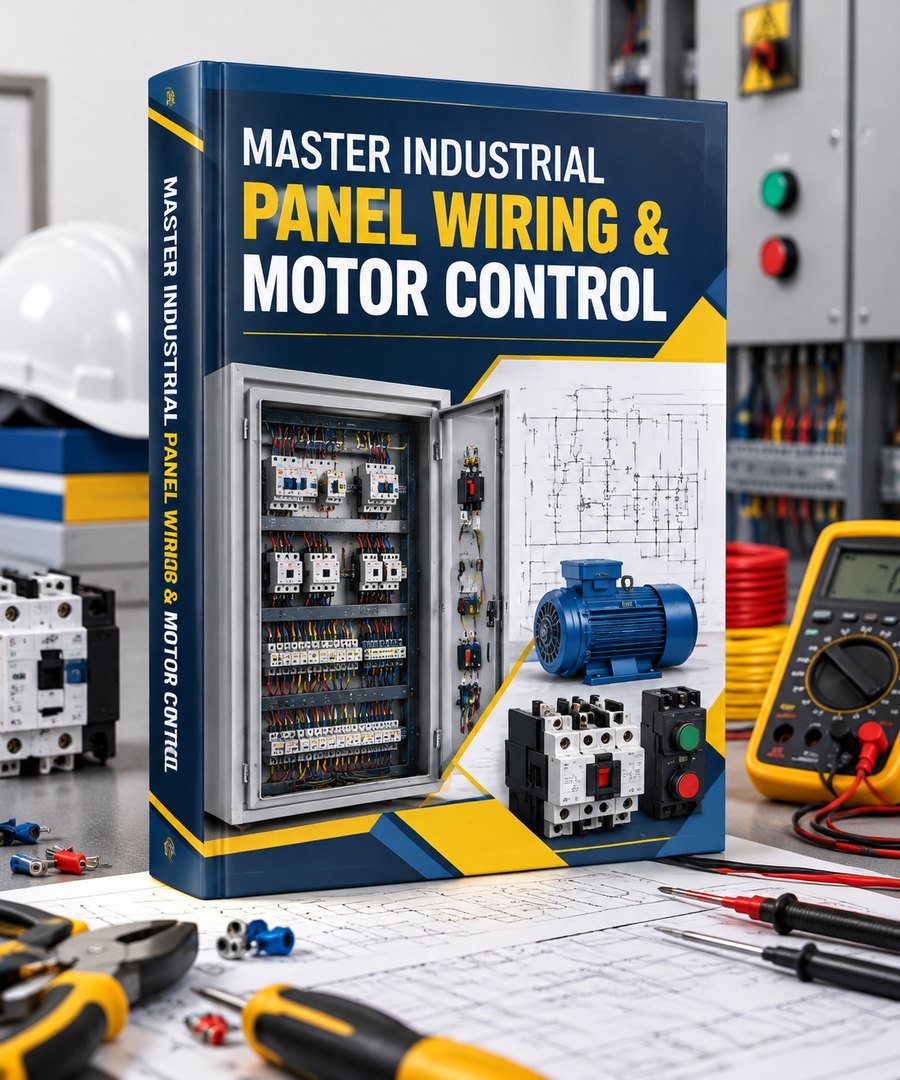
Cover of the Master Industrial Panel Wiring and Motor Control practical guide
350+Pages of practical content
100+Real circuit diagrams
0 → ProBeginner to advanced path
PDFInstant access after payment

Knowing theory is not the same as wiring a live panel

Most electricians in India learn formulas, symbols and definitions — and then freeze in front of an open control panel. This is where the gap shows up.

Diagrams look like a puzzle

You can read a single line diagram, but a full control schematic with interlocks, auxiliary contacts and NC/NO logic takes an hour to decode — if at all.

Fault finding turns into guesswork

The motor hums and does not start. You change the contactor, then the overload relay, then the fuse — and the real cause was one loose neutral.

Star-delta is copied, not understood

You can wire it because a senior showed you once. Change the timer setting or the motor rating and the confidence disappears.

No one explains selection

Which contactor rating, which cable size, which overload setting for a 7.5 kW motor? Guessing here burns panels and reputations.

Senior technicians hold back

On site, nobody has time to teach. You are told what to do, never why — so the same doubt returns on the next machine.

Salary stays flat

Helpers who can only pull cables get helper pay. The technician who can commission a panel and clear a breakdown gets called first and paid more.

The missing piece is not more theory. It is a structured, diagram-first reference that shows how a real industrial panel is built, powered, protected and repaired.

A field manual written the way panels are actually built

This guide takes you from an empty enclosure to a commissioned, tested and documented control panel. Every concept is tied to a drawing, every drawing is tied to a job you will be asked to do.

  • Diagram first, text second. Power circuit and control circuit are drawn separately, then joined, so you can follow the current path with your finger.
  • Indian site reality. 415 V three phase, 230 V control, IS-marked components, the makes and markings you see in local panels.
  • Selection tables you can use on site. Motor rating to contactor, overload range, fuse, MCB and cable size in one place.
  • Fault trees, not guesses. Symptom, likely cause, test point, measured value, action — in that order.
  • Safety built in. Isolation, lockout, discharge and testing procedure before every live-work chapter.
Get instant access for ₹299

One-time payment. No subscription, no renewal.

Technician holding a control schematic while probing a contactor terminal inside a panel
Every chapter follows the same loop: read the drawing, trace the circuit, test the point, record the reading.

Look inside before you buy

Clean, printable pages — large diagrams, labelled terminals and short explanations. No filler, no walls of text.

Sample pages from the wiring and motor control chapters

What a typical page gives you

  • A full-width circuit diagram with terminal numbers matching real component markings (A1, A2, 13-14, 95-96).
  • Test points marked on the drawing with the voltage or continuity reading you should expect.
  • A short "what goes wrong here" box based on breakdowns that actually repeat on site.
  • Plain English written for Indian technicians — no exam language, no unnecessary derivations.
Control panel interior with contactors and wiring Close-up of ferruled control wiring on a DIN rail Multimeter and hand tools on a workbench with schematics

What you will learn, chapter by chapter

The book runs in the same order a panel is built — supply, protection, control, motor, testing, documentation.

01

Reading electrical drawings

Symbols, single line diagrams, power vs control circuits, wire numbering, ferruling and how to follow a drawing without losing the path.

02

Panel layout and enclosure planning

DIN rail and mounting plate layout, wire duct sizing, cable entry, segregation of power and control, heat and IP rating basics.

03

Incoming supply and protection

Three phase supply, busbar and terminal arrangement, MCB, MCCB, fuse and RCCB selection, short circuit vs overload protection.

04

Control circuit fundamentals

Control transformer, 230 V and 24 V control, NO and NC contacts, latching and holding circuits, interlocking logic explained step by step.

05

Contactors, relays and overload relays

Coil and auxiliary terminals, AC-1 and AC-3 duty, contactor rating selection, thermal vs electronic overload setting for a given motor.

06

Motor starters from DOL to VFD

DOL, star-delta, forward-reverse, autotransformer, soft starter and VFD — power circuit, control circuit and where each one belongs.

07

Timers, sensors and automatic control

On-delay and off-delay timers, float and level switches, limit switches, pressure switches, auto-manual selection and sequence control.

08

Wiring practice and workmanship

Wire colour code, lug and ferrule crimping, torque, dressing, earthing and bonding, labelling — the details that decide if a panel passes inspection.

09

Testing and commissioning

Pre-power checks, insulation resistance, continuity, phase sequence, no-load and on-load trial, current balance and overload setting verification.

10

Fault finding on live panels

A repeatable method: isolate, observe, divide the circuit, measure, confirm. Applied to 30+ real breakdowns with readings and conclusions.

11

Preventive maintenance

Thermal checks, tightening schedule, contact wear, filter and fan care, megger records and the panel history sheet format.

12

On-site reference tables

Motor kW to full load current, contactor and overload selection, cable size, fuse rating, common terminal markings and standard wire colours.

Every component inside the panel, explained

Construction, terminal markings, rating selection, common failures and how to test it with a multimeter.

MCB & MCCB

Curve types, breaking capacity, rating for motor circuits.

RCCB & ELCB

Leakage protection, 30 mA vs 300 mA, nuisance tripping causes.

Contactor

A1-A2 coil, main and auxiliary contacts, AC-3 rating selection.

Overload relay

Thermal and electronic types, setting range, 95-96 and 97-98 contacts.

Timers

On-delay, off-delay, star-delta changeover timing and adjustment.

Control relay

Multi-contact relays, base wiring, using relays to extend contacts.

Push buttons & selectors

Start, stop, emergency stop, two-way and three-way selector wiring.

Indicator lamps

Run, trip and supply indication, phase indication, lamp test circuits.

Single phase preventer

Phase failure and unbalance protection, wiring into the control circuit.

CT, ammeter & voltmeter

CT ratio, selector switch wiring, why a CT secondary must never open.

Terminals & busbar

Terminal blocks, earthing bar, busbar sizing and support spacing.

VFD & soft starter

Power and control terminals, basic parameters, start and speed reference.

Six motor starters, wired and explained end to end

For each starter you get the power circuit, the control circuit, the sequence of operation, the selection rule and the faults it typically throws.

Motor starters covered in the guide with typical application and key skill
StarterTypical motor sizeWhere it is usedWhat you master
DOL starterUp to about 7.5 kWPumps, small fans, compressorsHolding contact, stop-start logic, overload wiring
Star-delta starter7.5 kW and aboveMachines with light starting loadTimer changeover, 6-terminal motor connection, interlock
Forward-reverseAny ratingConveyors, hoists, gatesMechanical and electrical interlocking, phase reversal
AutotransformerLarge motorsHeavy starting load, limited supplyTap selection, transition sequence, protection
Soft starterMedium to largePumps, belt drives, smooth ramp-upBypass contactor wiring, ramp and current limit settings
VFD driveAny ratingVariable speed process controlPower and control terminals, basic parameters, fault codes

Power circuit drawn separately

Incomer, contactor, overload, motor terminals — so you can wire the main circuit before touching control.

Control circuit line by line

Each rung explained: what closes, what holds, what breaks the circuit and why the sequence cannot be changed.

Commissioning checklist

The exact order of checks before first start, and the readings that confirm the starter is healthy.

Get instant access for ₹299

Download starts immediately after payment.

Fault finding, reduced to a method

30+ documented breakdowns follow the same five-step structure, so the method sticks even when the machine is new to you.

  • Observe the symptom precisely — what runs, what trips, what only fails under load.
  • Split the circuit into supply, control and power sections and test each boundary.
  • Measure at the marked test point and compare against the expected value.
  • Confirm the root cause before replacing anything — not after.
  • Record the reading and the fix so the same fault is solved faster next time.

Motor hums but does not rotate

Likely cause
Single phasing — one phase missing at the motor terminal.
Test
Voltage across all three phases at the overload outgoing terminals with the contactor pulled in.
Action
Trace the missing phase back through fuse, contactor pole and cable joint.

Overload relay trips repeatedly

Likely cause
Wrong setting, unbalanced current, mechanical jam or under-voltage.
Test
Clamp current on each phase and compare with the motor nameplate full load current.
Action
Correct the setting, then check the load and supply before blaming the relay.

Star-delta does not change over

Likely cause
Timer contact, interlock contact or delta contactor coil circuit open.
Test
Voltage at the delta coil A1-A2 at the moment of changeover.
Action
Follow the interlock path in the drawing and isolate the broken rung.

Control fuse blows on start

Likely cause
Shorted coil, damaged control wire or a pinched conductor in the duct.
Test
Coil resistance and insulation of the control loop with the supply isolated.
Action
Replace the faulty coil or wire — never a higher rated fuse.
Open industrial control panel with contactors, breakers and a VFD
Faults are diagnosed on the drawing first, then confirmed at the terminal — not the other way round.

Who this guide is written for

If you work with, or want to work with, industrial control panels, it starts at your level and takes you further.

ITI students & apprentices

Electrician, Wireman and Instrument trades — fills the practical gap between syllabus and shop floor.

Diploma & engineering students

Electrical and EEE students preparing for plant interviews, internships and campus placement tests.

Maintenance technicians

Anyone who is called at 2 am for a breakdown and needs a method instead of trial and error.

Panel builders & wiremen

Assembly, wiring, testing and documentation standards that get panels accepted the first time.

Electrical contractors

Quote correctly, select the right components and train your team with one common reference.

Site supervisors & engineers

Check other people's work confidently and speak precisely about starters, protection and faults.

Cover of the Wiring System and Fault Finding Guide bonus ebook
Free bonus with today's order

Wiring System & Fault Finding Guide

A second book that goes wider than the panel — building and machine wiring systems, earthing, testing instruments and a structured fault finding workflow you can apply anywhere on site.

  • Wiring systems and cable routing methods
  • Earthing, bonding and leakage testing
  • Multimeter, clamp meter and megger use
  • Continuity, insulation and polarity checks
  • Symptom-to-cause fault charts
  • Safety and isolation procedure
Free today Normally sold at ₹99 — added automatically to your download when you order the main guide now.
Get both books for ₹299

What readers say after using it on site

Feedback from technicians, students and panel builders across India.

The star-delta chapter finally made the timer changeover clear. I wired a 15 kW panel alone last week and it started on the first trial.

RK
Rakesh KumawatPanel wireman, Jodhpur

I keep the PDF on my phone. During a breakdown I checked the fault chart for repeated overload tripping and found an unbalanced phase in ten minutes.

SP
Suresh PatilMaintenance technician, Pune

Our ITI practicals only covered basics. The selection tables for contactor and overload were the part I used most in my interview.

AM
Ajay MeenaITI Electrician, Jaipur

I gave the PDF to my two helpers. Now they understand why the interlock exists instead of copying the wiring from an old panel.

MI
Mohammed IrfanElectrical contractor, Hyderabad

The commissioning checklist is the real value. Insulation, phase sequence, no-load trial — in the correct order, with the readings to expect.

VN
Vignesh NairPlant engineer, Coimbatore

Diagrams are large and printable. I printed the motor starter pages and stuck them inside our workshop cupboard for the team.

DS
Deepak SahuShift technician, Raipur

Everything you get today

Complete practical bundle

Two PDFs, delivered instantly after payment

  • Master Industrial Panel Wiring & Motor Control — 350+ pages₹1,499
  • 100+ real circuit diagrams, printableIncluded
  • Motor starter pack: DOL to VFDIncluded
  • 30+ documented fault finding casesIncluded
  • On-site selection tablesIncluded
  • Bonus: Wiring System & Fault Finding Guide₹99
  • Lifetime access and future updatesIncluded
  • Your price today₹299
Get instant access for ₹299 UPI · Card · Net banking · Wallet
Secure payment Instant download One-time payment

Questions before you order

Is this a printed book or a PDF?
It is a digital PDF. As soon as your payment is confirmed, the download link opens on the success page and the same link is emailed to you. There is no shipping and no waiting.
I am an ITI first year student. Will I understand it?
Yes. The first chapters cover symbols, drawings and control circuit basics before any starter is introduced. If you know what a contactor and an MCB are, you can follow from page one.
Can I read it on my mobile phone?
Yes. The PDF opens on any Android or iPhone, tablet, laptop or desktop. Diagrams are drawn large so they stay readable on a phone, and the pages print cleanly on A4 if you want a hard copy for the workshop.
Is the content in Hindi or English?
The guide is written in simple English, using the terms and component markings used on Indian sites. Most readers with ITI or diploma level English follow it without difficulty.
Does it cover VFD and PLC panels?
VFD wiring, basic parameter setting and common fault codes are covered, along with an introduction to PLC based control panels and how they replace relay logic. Detailed PLC programming is a separate subject and is not the focus of this guide.
How long do I get access?
Lifetime. Download the file once and it is yours to keep on any device. Revised editions are sent to the same email address at no extra cost.
What if the download does not work?
Write to the support email with your payment reference and the file will be sent to you directly, usually within a few hours. Because the product is delivered instantly, sales are otherwise final.
Which payment methods are accepted?
UPI, debit and credit cards, net banking and popular wallets. Payments are processed on a secure gateway page; card details are never stored on this website.

One panel you can wire and troubleshoot alone changes your pay grade

350+ pages, 100+ circuit diagrams and the free fault finding guide — for less than the cost of one contactor.

₹1,499 ₹299

Secure payment · Instant PDF · Lifetime access